Conversation With A Forensic Investigator
National Forensic Science Week
Those who wear a gun and badge are not the only ones who step behind the crime scene tape; our forensic investigators are there too, helping to find the truth through science. Through crime scene documentation and reconstruction, specialized photography, DNA collection, and blood pattern analysis, forensic investigators help deputies solve cases faster and provide much-needed answers to those affected by crime.
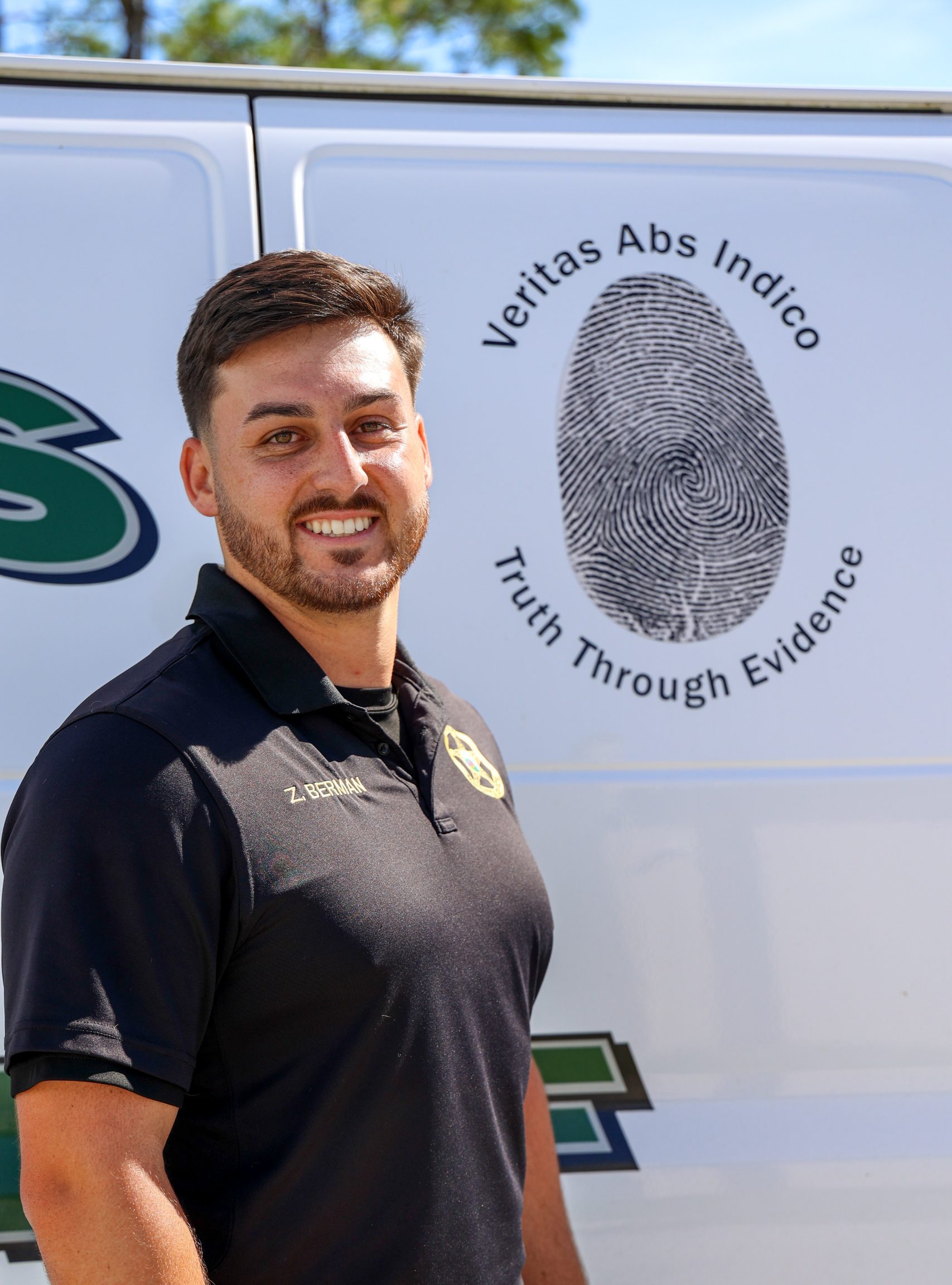
For National Forensic Science Week, we sat down with Forensic Investigator Zachary Berman to learn more about this section and the valuable work they perform for our community.
What kind of calls do forensic investigators respond to?
We never really know what’s going to come in on a day-to-day basis. But we’re prepared to handle whatever comes our way. Some of those cases include burglary of a car, a business, or a residence, death investigations, assaults or batteries, arsons, search warrants, narcotics offenses, a little bit of everything. We see it all.

Can you explain what the process is like when you arrive at a scene?
When we get on scene, our goal is to understand the scene before we walk into it. We’ll get a brief of pertinent preliminary information from some of those deputies and detectives. But we remain unbiased. We create our own investigation in our head as we go along. We tend to do a walkthrough of the scene and just see where things are located and what needs to be documented. We have to take into account that anything is possible and evidence could be anywhere.

What is the process once you return to the office?
It really depends on the item. Some items are as simple as collecting, photographing, and submitting them as evidence. Others may require some additional processing. I’ve been to scenes where all I’ve had to do is take pictures, and others where we’ve collected upwards of 100 pieces of evidence. We use several steps to process for DNA and fingerprints in an attempt to obtain more evidence. Once these items are processed and packaged, we submit them to a secure locker for Property and Evidence to take custody of them for storage.
PSO has a latent print unit within the Forensic Service Division. What is it like working with latent print examiners and how do you coordinate for investigations?
They are fantastic people, as are they workers. We work very closely with them. We’re actually in the same office. How we coordinate with them is we may collect a print on scene or at the office while processing. We turn these latent lifts and photos over to our Property and Evidence section, who then transfer them to the Latent Unit for analysis. Their goal is to manually compare these latent prints and attempt to identify who they may belong to, whether that’s manually or through the database. A keen eye and patience are crucial, and they excel in both.

We know Forensic Investigators work very closely with patrol deputies and latent print examiners for cases. Are there any other units you work closely with?
Yes. We work alongside detectives while in the field. We work pretty closely with a lot of major crimes detectives and property crimes detectives. Throughout the evidence cycle, we also work with the Property and Evidence Unit. I have had nothing but positive experiences with all units and believe that they are great at what they do. We all work towards a common goal of working hard for the people of Pasco County.
What are some of the biggest challenges that come with being a Forensic Investigator?
Several come to mind with being in forensics and especially in law enforcement. Our goal in this field is accuracy. We let the evidence do the talking, but we are responsible for said evidence and ensuring that it is secured and accurate at all times. At the end of the day, our evidence can influence a case’s direction or an outcome. The other side of it is mental stress and the internalizing of emotions. We do see some interesting scenes, but we also see the sad or more emotional parts. The mental toll of some of the calls we respond to can be heavy, and oftentimes these feelings are internalized. But we’ve got a great, strong unit and great support from all around, internal and external. Forensic Investigators also occasionally work in hazardous locations and need to be extra careful while completing our work.
Crime shows that feature forensics work have generated interest in this field, but they may have also create some misconceptions. What are some myths about forensic investigations?
The CSI effect is real! We all love the TV shows. They’re fun; they’re glamorous. You get to see the entire investigation from start to end in just an hour. Now that’s where some of those myths come in. It may take me just an hour to go to a call. Some of our cases could take days, weeks, months, and years to complete. And, the perfect evidence, it’s not always present. The fingerprint isn’t always going to be super visible. All the dots are not going to connect right away. We work really hard to obtain results from that evidence. And it’s not just a quick and easy fix. The only time we can make fingerprints appear out of thin air is if we’re using black powder. We also work in teams to get the job done — one person is not responsible for everything.

For anyone who’s interested in a career with forensics, what kind of education and training are needed? And do you complete any additional training while in this position?
While an Associate degree is typically required, it’s highly recommended to have a Bachelor’s in a Science, Criminal Justice, or a related field to be prepared for the role of a Forensic Investigator. Previous experience and training, such as internships or volunteer work, are very important to entering the field. One thing that I always love talking about, and why I love to help with volunteers and internships, is that the experience you can gain in those early years throughout your education is crucial. Being able to say that you’ve been at a crime scene and that you’ve seen something processed is so important. Now, as far as training goes, we do plenty of in-house training.
We have a rigorous six-month training program for all trainees that come through our unit. This training is split into four parts and includes observational, hands-on, and lead-role phases. One of our goals in the office is that if you learn something new and fascinating that you think is beneficial, we teach it. So I’ve hosted a training. Several other investigators have hosted trainings, whether that be related to firearms, to blood, to new technology. We also go to multiple trainings offered by our agency or others.
As a Forensic Investigator you are issued a van to transport all the equipment you may need while processing a crime scene. What kind of equipment do you travel with?
The agency vehicles are a huge benefit that we have here at the sheriff’s office. It’s basically our whole office all in one. Our vans are stocked to the brim with anything from gloves, swabs, scales, black powder, tape, hazmat suits, and bags, all the way up to some of our more technological stuff, like our alternate light sources. But our most important piece of equipment is our camera. We take a lot of pictures, and it is a huge part of our job!

Your unit also keeps larger equipment and machines at the office for your investigations. What kind of equipment do you use at the office?
We all use our computers and laptops, but we also have cameras and a lot of processing equipment. The main processing equipment we use on an everyday basis is the cyanoacrylate/superglue chamber, a UV/IR camera, black magnetic powder, latent chemicals, including Ardrox, RAM, M-Star, and our alternate light source. All of those are used to process our items. They all have their own specific uses, and our unit continues to grow and advance with our processing techniques.
Do you have any predictions for how this field will change in the future? Or is there anything you are hoping to see with advancements in the field?
One of the things that I love to explore and to touch on is the technology and the growth of the field. As I kind of mentioned, some of those alternative light sources- those are things that have advanced so much that there are auto functions, there are new filter combinations, there are upgrades in photography. So the technology is something that I’m really excited to see and how it advances over the years. With so many people who know so much about the field combined with new faces who are eager to make it even better, I believe Forensics is in a great spot and will only continue to grow as time progresses.


Want to be the first to know?
Sign up for future updates direct to your inbox, or download the Pasco Sheriff News App Today!